

AlmosN8kd
Well-Known Member
- 557
- 346
- Vehicle Model
- 2012 Honda Civic Si, 1994 Stealth R/T TT, 2009 CBR1000RR, 2016 Pilot Touring AWD
- Body Style
- Sedan
So, this is a bit of a long one for what basically amounts to a simple modification to remove the factory boost gauge… which, if we’re being honest, has been about as helpful as a horoscope since I switched ECUs. Anyway, here we go.
Many years ago—somewhere around 2007, when flip phones still roamed the Earth—I ditched the factory ECU for an AEM EMS Series 1, which I’m still running to this day like the stubborn creature I am. Those of you who may be familiar with the 3/S platform, may know the factory boost gauge is relatively useless under ideal conditions. With an aftermarket ECU? It becomes actually useless. As in: dead. Decorative. A small, politely lit circle that contributes nothing to society.
Back when AEM still had forums (RIP), someone posted a write-up on how to make the factory gauge play nicely with the EMS. I didn’t save the info, because why would I do something practical like that? And now it appears to have been Thanos-snapped from existence forever. Probably. I spent a full zero seconds actually searching for it.
Fast forward to 2014. I scored a set of center gauges from a Euro 3000GT—basically the same as the GTO cluster but mirrored for LHD, so they practically drop into a USDM car. Like the RHD GTO version, the Euro one has that combo Boost-Temp gauge I didn’t want. So I started a project to replace the combo gauge with a US temp gauge. Simple, right?
View attachment 68332
Well… in theory, yes. In practice? The project stayed “in progress” for about 10 years. In 2015 I packed it up for a move, shoved it in a box, and granted it the same attention most people give their treadmill after the first week of January.
Earlier this year, with the dash out for yet another unrelated reason, I figured “while I’m in there” (the four most dangerous words in any car project), I might as well resurrect this little archaeological artifact. And amazingly… I think I actually finished it. Probably. I’ve tested everything on the bench, but the car isn’t reassembled yet, so we’re at the “optimistic but fully prepared for shenanigans” stage.
Anyway—here’s what actually went into this. It looks simple. It is not simple:
The US temp gauge now works using the signals from the plug. The signal pickups live in different places on the Euro combo gauge, because of course they do.
View attachment 68334
The gauge now lights correctly. The Euro light collector lives in a different spot (it is at the bottom of the gauge, where the US one is up and off to the side - see pic above), so you have to mount a bulb remotely inside the gauge like you're installing a tiny aftermarket sun.
The gauge now lights the correct color. This is actually where the project died for years. In 2014 I tried to stuff a white LED in there, but it turned everything a weird yellow that made the rest of the cluster look sickly. LED technology has thankfully evolved since then, so this problem is finally solvable without a séance.
The plug needed a full repin, because none of the OEM schematics matched what I was doing. Thankfully, the pins pop out easily, so this ended up being more “mild annoyance” than “existential crisis.”
View attachment 68335
The inner bezel needed plastic surgery, using bits from two different gauge sets because the half-moon cutouts for the needles didn’t line up. Frankengauge was born.
Cosmetic nostalgia: Back in 2014, you could still buy white faces that matched my setup. The companies that made them seem to have vanished sometime during COVID (moment of silence), so what I’ve got is what I’ve got. Same goes for the BS carbon-fiber stickers I slapped onto my original set years ago; I was able to get some at the same time to use for this project so it was an easy direct swap.
So, here are some final pics to compare things, the final unit, comparing to my cosmetically modified stock setup, and the installed look (dash is still out of the car though):
View attachment 68333 View attachment 68336 View attachment 68337
And, since this required a special pinout, I wired in both plugs to the dash harness (while also wiring in the plug for the clock) so I can switch back to my OEM unit pretty easily (if desired - or, I realize I have failed, it all goes up in smoke, and I have to put it back into a box for another 10yrs):
View attachment 68331
And . . . yes, I did cut that zip-tie, after the pic.
So, started trying to test this and was having issues; primarily, when I turned the lighting on, the clock wouldn’t light up for some reason.
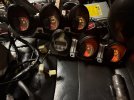
Ignition off, lights on
However, if I turned the ignition on, it would:
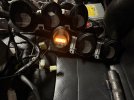
Ignition on, lights off
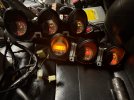
Ignition on, lights on
So, while I was certain I wired this correctly, the weird response had me confused and going through things over and over, looking at and cross-referencing schematics, trying to figure out why, when the lights were on, the clock was dark. I had to have done something wrong. However, no matter what I changed, it was the same. I was getting extremely frustrated.
Finally, a buddy in Japan sent me a video from their GTO, and confirmed this was proper operation of the clock lighting. What a colossal pain and a relief all at the same time. I can’t seem to share the video though (can’t attach it here and can’t seem to push it to YouTube I think since it’s not my video).


 Morning.
